Syrian President Meets SDF Commander, Autonomous Administration Official on Integration
Source: Asharq Al-Awsat
Original summary written by Tharwa from the source above. How we source and correct stories
The story in brief
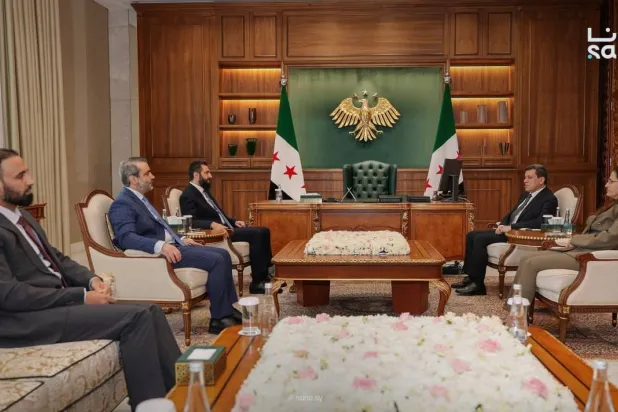
Syrian President Ahmad al-Shar' met with Mazloum Abdi, commander of the Syrian Democratic Forces (SDF), and Ilham Ahmed, head of foreign relations for the Autonomous Administration, in Damascus. The Tuesday meeting at the People's Palace discussed completing the implementation of the January 29 agreement and continuing the integration process within state institutions. Foreign Minister Asaad al-Shaibani and Deir ez-Zor Governor Ziyad al-Aish were also present. Abdul Karim Omar, the Autonomous Administration's representative in Damascus, confirmed no final agreement was announced regarding the dissolution of the SDF or the Autonomous Administration's institutions, stating that negotiations are ongoing to achieve national unity and stability.
Detailed summary
Syrian President Ahmad al-Shar' hosted Mazloum Abdi, commander of the Syrian Democratic Forces (SDF), and Ilham Ahmed, head of foreign relations for the Autonomous Administration, on Tuesday at the People's Palace in Damascus. The meeting, which was also attended by Foreign Minister Asaad al-Shaibani and Deir ez-Zor Governor Ziyad al-Aish, centered on advancing the implementation of the agreement signed on January 29 and monitoring the integration of these entities into state institutions.
Prior to the meeting, Abdul Karim Omar, the Autonomous Administration's representative in Damascus, announced that the gathering would address challenges hindering political and military integration efforts. Following the discussions, Omar informed the 'Syria Now' platform that no official announcement had been made concerning a final agreement on dissolving the SDF or the Autonomous Administration's institutions. He added that negotiations are currently underway to formulate a national solution that would ensure Syria's unity and stability, while safeguarding the rights of all Syrians. This underscores the ongoing nature of the process aimed at achieving comprehensive national solutions.
Background & context
This story sits within GCC's broader reform agenda and efforts to grow Capital Markets as a pillar of non-oil GDP. The region benefits from supportive energy prices, expansionary government budgets, and rising interest from sovereign wealth funds and foreign investors.
Key numbers & facts
- No specific figures were provided in the available source. See the original publisher for detailed numbers.
Key points
- Syrian President Ahmad al-Shar' met with Mazloum Abdi, commander of the Syrian Democratic Forces (SDF), and Ilham Ahmed, head of foreign relations for the Autonomous Administration, in Damascus.
- The Tuesday meeting at the People's Palace discussed completing the implementation of the January 29 agreement and continuing the integration process within state institutions.
- Foreign Minister Asaad al-Shaibani and Deir ez-Zor Governor Ziyad al-Aish were also present.
- Abdul Karim Omar, the Autonomous Administration's representative in Damascus, confirmed no final agreement was announced regarding the dissolution of the SDF or the Autonomous Administration's institutions, stating that negotiations are ongoing to achieve national unity and stability.
Why this matters
This matters because activity in Capital Markets, Banking shapes capital flows, hiring and investor sentiment across GCC.
Economic & market impact
Potential impact: - Listed GCC equities and indices may see direct trading reaction. - Banks may see shifts in mortgage, project finance and corporate lending pipelines.
GCC angle
For the rest of the GCC, this is a signal on the pace of activity in Capital Markets, Banking. Capital flows and regulatory decisions in one Gulf state typically travel across borders given the similar economic structures and the coordination inside the GCC framework.
Risks & uncertainty
There is uncertainty around the read-through: projections can be moved by swings in oil prices, by US monetary policy tightening that most GCC central banks track via dollar pegs, and by regional geopolitical events. Headline numbers may also be revised when subsequent official data is published.
What happens next?
Watch for upcoming disclosures from listed names in Capital Markets, Banking, official macro releases for GCC, and any commentary from regulators or sovereign wealth funds. Tharwa will refresh this briefing as new public information becomes available.
Sources used
This is an original Tharwa briefing based on the available source material. Read the full article from the publisher.
Tharwa Weekly
One weekly digest of the GCC economy, companies, markets and investment opportunities — clear and concise.