Kuwait Stock Exchange Erases Annual Losses, Returns to Profitability
Source: Al Jarida (الجريدة) — اقتصاد
Original summary written by Tharwa from the source above. How we source and correct stories
The story in brief
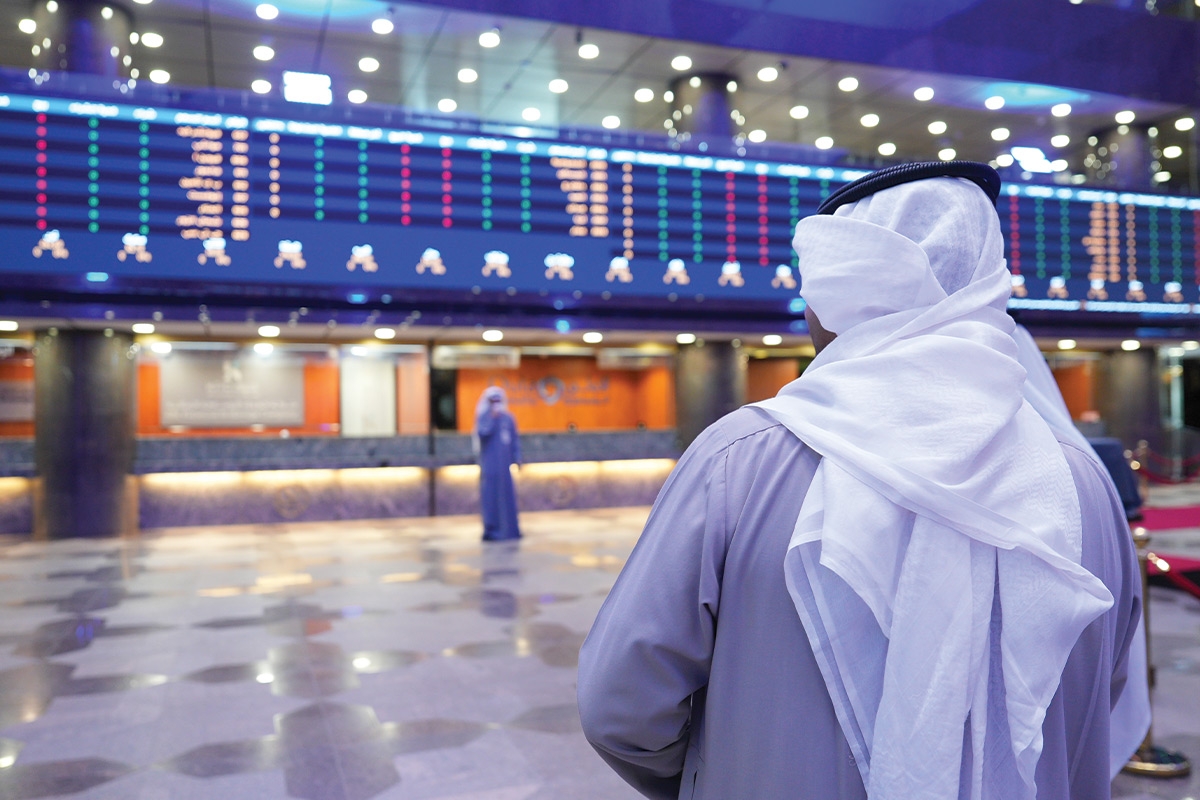
The Kuwait Stock Exchange witnessed a notable turnaround, eliminating year-to-date losses supported by a collective rise across its indices. The market capitalization, which had suffered a 544.9 million dinar loss by Sunday, gained 702.1 million dinars on Monday, reaching 53.34 billion dinars. This recovery was driven by easing geopolitical tensions and optimism for a US-Iran agreement, alongside better-than-expected first-half results from many listed companies. Trading liquidity surged by 44.4% to 84.1 million dinars, with the Premier Market accounting for 75%.
Detailed summary
The Kuwait Stock Exchange experienced a remarkable shift in its performance, successfully erasing its year-to-date losses, bolstered by a collective increase across its indices. The market capitalization, which had incurred losses of 544.9 million dinars (a 1.02% decrease) by the close of Sunday's session, gained 702.1 million dinars during Monday's session, bringing the total market capitalization to 53.34 billion dinars. This improvement was attributed to a 1.33% rise in the All-Share Index, adding 117.39 points to close at 8913 points. The Main Market Index surged by 5.22%, adding 457.42 points to reach 9216 points, while the Premier Market Index increased by 0.55%, adding 51.07 points to reach 9312 points.
The bourse's rally was further supported by the de-escalation of geopolitical tensions in the region and growing optimism regarding a potential agreement between the United States and Iran, which has positively impacted investor sentiment and increased demand for various listed stocks. Additionally, better-than-expected first-half results announced by several companies boosted purchasing activities in leading and operational stocks.
Traded liquidity jumped by 44.4%, reaching 84.1 million dinars, compared to 58.2 million dinars during Sunday's session. The Premier Market captured the largest share of this liquidity at 75%, with the Main Market accounting for the remaining 25%. The session saw strong gains for several stocks, led by Gulf Insurance, which recorded the highest increase of 125.58%, albeit with a limited number of shares. Systems, Equipment, and Al-Deera also performed well, while Al Kout topped the list of most declining stocks.
Out of 131 traded stocks, 68 saw price increases, 41 experienced declines, and 22 remained stable. Weighted indices for 10 sectors rose, led by the insurance sector at 50.24% and technology at 8.1%. Conversely, three sectors—consumer staples, healthcare, and basic materials & industrials—saw declines of 1.2%, 1.1%, and 0.31%, respectively. Total traded volumes amounted to approximately 296 million shares through 19,491 transactions. The Premier Market accounted for about 169.6 million shares via 11,565 transactions, while the Main Market recorded 126.4 million shares through 7,926 transactions.
In terms of value, KFH led the most traded stocks with 10.8 million dinars, closing at 790 fils. NBK followed with 7.9 million dinars (867 fils), GFH with 7.1 million dinars (176 fils), Arzan with 4 million dinars (319 fils), and Warba Bank with 2.8 million dinars (281 fils).
Gulf Insurance topped the list of gainers, rising 125.58% with 8.7 thousand shares traded, reaching 2.707 dinars. Systems followed with an 8.10% increase (1.62 million shares, 814 fils), Equipment with 4.19% (1.41 million shares, 224 fils), Al-Deera with 3.71% (382.3 thousand shares, 475 fils), and Petrolea with 3.71% (253 shares, 671 fils).
On the other hand, Al Kout saw the largest decline, dropping 9.57% with only 501 shares traded, closing at 794 fils. UPAK fell 4.48% (55.9 thousand shares, 192 fils), Umm Al Quwain by 4.35% (4.5 thousand shares, 132 fils), Ras Al Salmiya by 3.99% (1.891 million shares, 626 fils), and SAKB by 3.55% (101 thousand shares, 462 fils).
Background & context
This story sits within Kuwait's broader reform agenda and efforts to grow Capital Markets as a pillar of non-oil GDP. The region benefits from supportive energy prices, expansionary government budgets, and rising interest from sovereign wealth funds and foreign investors.
Key numbers & facts
- The market capitalization, which had suffered a 544.9 million dinar loss by Sunday, gained 702.1 million dinars on Monday, reaching 53.34 billion dinars.
- Trading liquidity surged by 44.4% to 84.1 million dinars, with the Premier Market accounting for 75%.
- The market capitalization, which had incurred losses of 544.9 million dinars (a 1.02% decrease) by the close of Sunday's session, gained 702.1 million dinars during Monday's session, bringing the total market capitalization to 53.34 billion dinars.
- This improvement was attributed to a 1.33% rise in the All-Share Index, adding 117.39 points to close at 8913 points.
- The Main Market Index surged by 5.22%, adding 457.42 points to reach 9216 points, while the Premier Market Index increased by 0.55%, adding 51.07 points to reach 9312 points.
Key points
- The Kuwait Stock Exchange witnessed a notable turnaround, eliminating year-to-date losses supported by a collective rise across its indices.
- The market capitalization, which had suffered a 544.9 million dinar loss by Sunday, gained 702.1 million dinars on Monday, reaching 53.34 billion dinars.
- This recovery was driven by easing geopolitical tensions and optimism for a US-Iran agreement, alongside better-than-expected first-half results from many listed companies.
- Trading liquidity surged by 44.4% to 84.1 million dinars, with the Premier Market accounting for 75%.
Why this matters
This matters because activity in Capital Markets shapes capital flows, hiring and investor sentiment across Kuwait.
Economic & market impact
Potential impact: - Listed GCC equities and indices may see direct trading reaction.
GCC angle
For the rest of the GCC, this is a signal on the pace of activity in Capital Markets. Capital flows and regulatory decisions in one Gulf state typically travel across borders given the similar economic structures and the coordination inside the GCC framework.
Risks & uncertainty
There is uncertainty around the read-through: projections can be moved by swings in oil prices, by US monetary policy tightening that most GCC central banks track via dollar pegs, and by regional geopolitical events. Headline numbers may also be revised when subsequent official data is published.
What happens next?
Watch for upcoming disclosures from listed names in Capital Markets, official macro releases for Kuwait, and any commentary from regulators or sovereign wealth funds. Tharwa will refresh this briefing as new public information becomes available.
Sources used
This is an original Tharwa briefing based on the available source material. Read the full article from the publisher.
Tharwa Weekly
One weekly digest of the GCC economy, companies, markets and investment opportunities — clear and concise.