Trump Accuses Tehran of Duplicity, Demands 'Complete Surrender'
Source: Al Bilad Bahrain (البلاد)
The story in brief
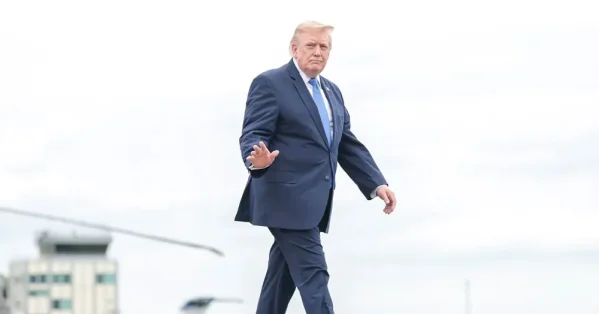
US President Donald Trump on Monday accused the Iranian leadership of duplicity, stating they requested a meeting and initiated talks with Washington, only to publicly deny negotiations and claim communications were limited to Oman. Trump asserted that nothing would reach Iran without US approval, and a naval blockade would persist until an agreement or 'complete surrender' is achieved. He also rejected Iran's claims of control over the Strait of Hormuz, maintaining it is under full US Navy control. These remarks follow a temporary suspension of planned US attacks on Iran, which Trump attributed to potential diplomatic progress.
Detailed summary
US President Donald Trump on Monday accused the Iranian leadership of duplicity, stating they requested a meeting and initiated talks with Washington, only to publicly deny negotiations and claim communications were limited to Oman. Writing on his Truth Social platform, Trump said Iranian officials had requested, or 'begged' for, a meeting, and that talks had begun with future meetings planned.
He added that the Iranian leadership publicly and proudly declares no negotiations are taking place with the United States, asserting that their communications are limited to Oman, which he believes contradicts behind-the-scenes developments. This post came hours after he told journalists that the United States had begun 'talking to Iran' in a negotiating format, and a new round would start on Monday, without specifying the location or participants.
In response, Iranian Foreign Ministry spokesman Esmail Baghaei denied any scheduled negotiations or meetings with the United States, stating that ongoing discussions are limited to navigation arrangements with Oman.
Trump escalated his conditions for ending the confrontation, stating that nothing would reach Iran without US approval, and the blockade would continue until an agreement or 'complete surrender' is achieved. He added that Washington and Tehran are discussing, whether Iran admits it or not, a solution to a crisis he said Iran had caused for decades, reiterating his pledge to prevent it from acquiring nuclear weapons. He declared: 'It's very simple, Iran will never have a nuclear weapon.'
Meanwhile, Trump rejected Tehran's assertions that it would maintain a strong role in managing the Strait of Hormuz, stating that the waterway is already under the complete control of the US Navy and the blockade imposed by Washington. He described the US naval blockade as 'the steel wall of the United States,' adding that nothing reaches Iran unless Washington permits it, and this situation will continue unless a settlement is reached on US terms.
Both sides present conflicting accounts regarding actual control of the strait, which has become a central issue in the conflict and the negotiations to end it. Washington asserts that freedom of navigation must be fully restored, and Iran has no right to subject vessel movements to its permits or specific routes. In contrast, Tehran insists on managing transit arrangements within waters near its coasts, rejecting the southern route supported by US forces alongside Oman. Iran and Oman are holding talks to establish a temporary corridor that mediates between the northern and southern routes, including two entry and exit lanes, pending an agreement on a permanent system for regulating ship traffic.
However, a common understanding between the two coastal states does not automatically mean the reopening of the strait. Tehran links any broader change to ending the US naval blockade, halting attacks, and allowing it to resume oil exports. Trump had conditioned, when announcing the suspension of a new attack on Iran, that any agreement must include the immediate, complete, and comprehensive opening of the Strait of Hormuz, alongside ending what he described as the Iranian nuclear threat.
In the latest maritime incident, the UK Maritime Trade Operations reported that a ship's captain reported an explosion in nearby waters while transiting the area, with no injuries or damage to the vessel. Trump announced on Saturday evening the suspension of a large bombing campaign that the United States and Israel were preparing to carry out against Iran, stating that strikes would remain suspended if an agreement could be reached quickly. The decision came a day after he said, during a government meeting at Camp David, that he was losing faith in negotiations, and warned that US forces would 'hit Iran very hard.'
White House spokeswoman Karoline Leavitt said at the time that Iran would continue to 'pay the price' until it returned to the negotiating table in a way Trump considered meaningful. However, the US president later announced indications of potential progress, stating that the attack was temporarily canceled to give diplomacy an additional chance. He clarified on Sunday that the military plan would have involved a large-scale operation, and Iran was aware of the extent of the attack after witnessing the preparations that preceded its execution.
He told journalists on Air Force One: 'Do I prefer to reach an agreement? I'm not looking to kill people,' before announcing the start of talks on Monday. The White House did not disclose the location of the meetings, the identity of mediators or participants, or the nature of the channel through which Trump said talks had begun. It also did not clarify whether his description of the talks included indirect messages through intermediaries or direct meetings between US and Iranian officials. Meanwhile, Trump's statements coincided with a series of contacts made by Iranian Foreign Minister Abbas Araqchi with regional officials, while Tehran denied the existence of a delegation directly negotiating with Washington. Araqchi discussed regional developments and ongoing diplomatic efforts with Pakistani Deputy Prime Minister and Foreign Minister Mohammad Ishaq Dar on Monday, agreeing to continue consultations to consolidate peace and security in the region.
Background & context
This story sits within Oman's broader reform agenda and efforts to grow the economy as a pillar of non-oil GDP. The region benefits from supportive energy prices, expansionary government budgets, and rising interest from sovereign wealth funds and foreign investors.
Key numbers & facts
- No specific figures were provided in the available source. See the original publisher for detailed numbers.
Key points
- US President Donald Trump on Monday accused the Iranian leadership of duplicity, stating they requested a meeting and initiated talks with Washington, only to publicly deny negotiations and claim communications were limited to Oman.
- Trump asserted that nothing would reach Iran without US approval, and a naval blockade would persist until an agreement or 'complete surrender' is achieved.
- He also rejected Iran's claims of control over the Strait of Hormuz, maintaining it is under full US Navy control.
- These remarks follow a temporary suspension of planned US attacks on Iran, which Trump attributed to potential diplomatic progress.
Why this matters
This matters because activity in GCC markets shapes capital flows, hiring and investor sentiment across Oman.
Economic & market impact
Potential ripple effects across GCC equities, banking activity and investor confidence. Watch listed regional names exposed to the story.
GCC angle
For the rest of the GCC, this is a signal on the pace of activity in the sector. Capital flows and regulatory decisions in one Gulf state typically travel across borders given the similar economic structures and the coordination inside the GCC framework.
Risks & uncertainty
There is uncertainty around the read-through: projections can be moved by swings in oil prices, by US monetary policy tightening that most GCC central banks track via dollar pegs, and by regional geopolitical events. Headline numbers may also be revised when subsequent official data is published.
What happens next?
Watch for upcoming disclosures from listed names in the sector, official macro releases for Oman, and any commentary from regulators or sovereign wealth funds. Tharwa will refresh this briefing as new public information becomes available.
Sources used
This is an original Tharwa briefing based on the available source material. Read the full article from the publisher.